|
|
|
|
|
|
|
|
|
Independent Test
of Spa Energy Use
|


| Spa # | Spa | Size Meters | Water Volume Liters |
| 1 | Beachcomber, 740 | 2.26x2.28x1.05 | 1474 |
| 2 | Sundance, Cameo | 2.28x2.30x1.01 | 1434 |
| 3 | Coast Spas, Lanai Silver | 2.38x2.36x1.09 | 1719 |
| 4 | Arctic Spas, Kodiak SS-1 | 2.36x2.36x1.04 | 1478 |
| 5 | Hot Springs, Vanguard | 2.54x2.31x0.97 | 1288 |
| 6 | Arctic Spas, Coyote C-60 | 2.35x2.35x0.88 | 1287 |
| 7 | XXX Spas, Atxxxic | 2.38x2.35x1.02 | 1476 |
| 8 | Arctic Spas, Kodiak SS-2 | 2.36x2.36x1.04 | 1579 |
2. TESTING SYSTEM DESCRIPTION
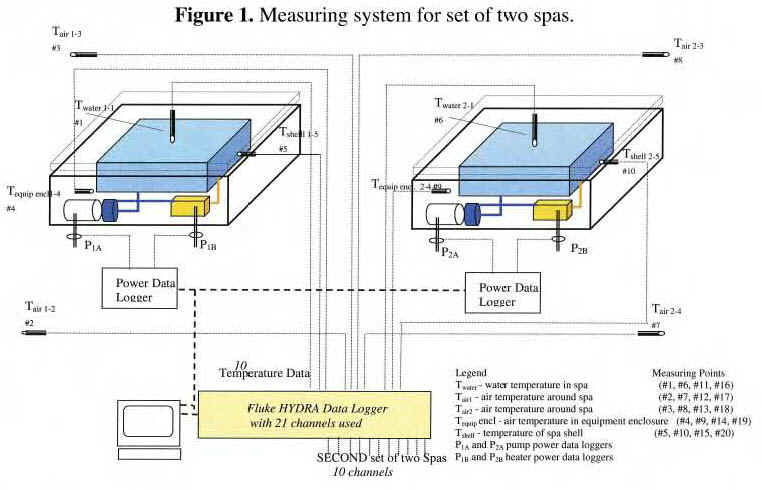
For the purpose of spa testing, a measuring system was developed as shown in Figure 1.
The measured parameters were;
- Ambient air temperature
- Water temperature in the spa
- Temperature of the spa shell
- Temperature in the equipment enclosure
- The power consumed by the pump; and
- The power consumed by the heater
To perform the spas evaluation a set of parameters and conditions were established for the testing. The first series of tests were performed at room temperature (about 20ºC). The second series of tests were performed in a freezer chamber at a temperature of about minus 15ºC.
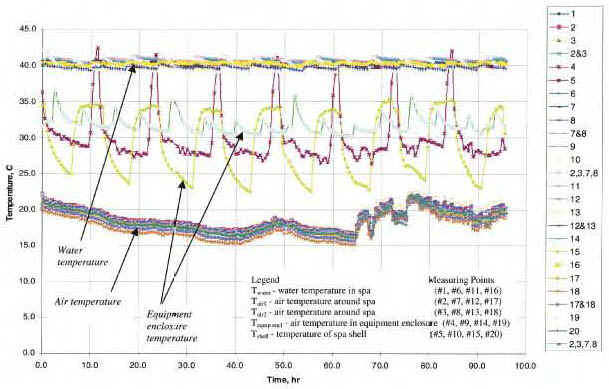
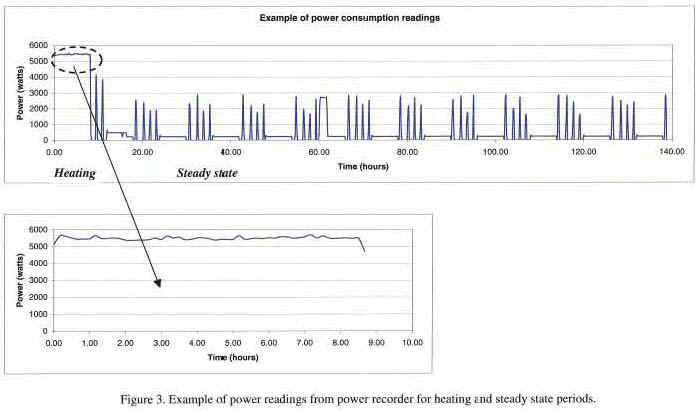
The temperature data was collected with Fluke HYDRA data logger with 21 channels. An example of data extracted at four simultaneously tested spas is given in Figure 2 on pg 4. A separate example of data loggers were used to collect data for power consumption evaluation. An example of data power consumption is shown in Figure 3 on pg 4.
STEADY STATE PERIOD RESULTS SUMMARY AND CONCLUSIONS
The results of resting at steady state are shown in Table S-I and Table S-2 on pg 6, and figure S-9.
To determine the long-term energy consumption of the spas two sets of conditions were applied for each spa: room temperature and low temperature. Tests at room conditions were influenced by variations of the surrounding air temperature. The temperature variations are obvious over long testing periods. It should also be noted that some of the room temperature tests were performed m the freezer room. The freezer room has an insulated floor. where as tests performed outside the freezer room were on a concrete floor. The difference in flooring may influence the thermal system since the bottom of the spa represents a significant heat exchange area.
The long term, steady state condition power consumption is one of the critical spa parameters for the spa user. Comparison of the power consumption and specific energy demand is shown in Figure S-9.
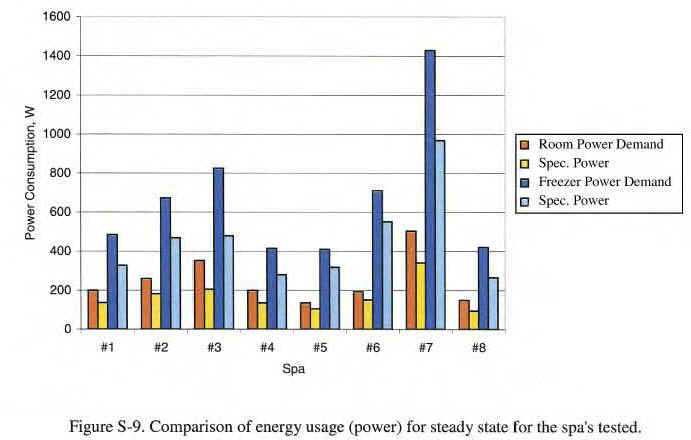
It may be concluded from Figure S-9 the energy consumption significantly increases when air temperature is decreasing. When decreasing temperature from 20ºC down to -13ºC on average the power demand increases 2.7 times indicating increased heat loss.
Assuming that the low temperature (-13ºC) tests are more indicative (significantly higher power demand) and considering the power consumption as a parameter for performance evaluation, the best performing spa would be (in order of best performing down):
Spa #8 Arctic Spas, Kodiak SS-2, Spa #4 Arctic Spas, Kodiak SS-1, Spa #5 Hot Springs, Vanguard, Spa #1 Beachcomber, 7-40, Spa #6 Arctic Spas, Coyote, Spa #2 Sundance, Cameo, Spa #3 Coast Spas, Lanai Silver, Spa #7 XXX Spas, Atxxxic.
Power consumption for steady state is influenced mainly by the overall spa thermal insulation. However, the size and usage frequency of the filtering systems and the way this system is installed also has impact on the spa performance. It is beneficial to the overall thermal efficiency of the system if some of the heat generated by the pump/motor can be retained in the system. In this case the heat will not be wasted energy but will contribute to the heating efficiency.
CONCLUSIONS
- Power consumption evaluated at steady state conditions is a good parameter for spa performance evaluation. This measure is useful to the consumer because it tells the consumer how much energy is required to operate the spa.
Table S-1. STEADY STATE at AMBIENT TEMPERATURE
| Spa # | Date | Spa | Water Volume Liters | Ave. Air Temp ºC | Water Temp ºC | Test Time h | ÅE kW | Number of heating cycles | Power demand W | Spec. Power W/m³ |
| 1 | Apr 24 | Beachcomber, 740 | 1474 | 20 | 41 | 94.3 | 18.82 | 4 | 200 | 136 |
| 2 | A29-M6 | Sundance, Cameo | 1434 | 20 | 40.5 | 142 | 37.15 | 24 | 260 | 181 |
| 3 | Apr 24 | Coast Spas, Lanai Silver | 1719 | 20 | 42 | 94 | 33.20 | 8 | 352 | 205 |
| 4 | Apr 24 | Arctic Spas, Kodiak SS-1 | 1478 | 19.5 | 40 | 94 | 18.83 | 32 | 199 | 135 |
| 5 | June | Hot Springs, Vanguard | 1288L* | 21 | 40 | 60 | 8.14 | 135 | 105 | |
| 6 | June | Arctic Spas, Coyote C-60 | 1287 | 21 | 41 | 84 | 16.18 | 7 | 193 | 150 |
| 7 | XXX Spas, Atxxxic | 1476 | 130 | 65.62 | 96 | 503 | 341 | |||
| 8 | Arctic Spas, Kodiak SS-2 | 1579 | 128 | 19.06 | 12 | 149 | 94 |
* -No auto-filtering! Filter cycle must be started manually
Table S-2. STEADY STATE in FREEZER
| Spa # | Date | Spa | Water Volume Liters | Ave. Air Temp ºC | Water Temp ºC | Test Time h | DE Wh | Heating Cycles Number | Power demand W | Spec. Power W/m³ |
| 1 | Apr 24 | Beachcomber, 740 | 1474 | -11 | 41 | 60 | 29,055 | 14 | 484 | 328 |
| 2 | A29-M6 | Sundance, Cameo | 1434 | -11 | 41 | 72 | 21,145 | 20 | 671 | 468 |
| 3 | Apr 24 | Coast Spas, Lanai Silver | 1719 | -14 | 41.5 | 60 | 49,465 | 5 | 824 | 479 |
| 4 | Apr 24 | Arctic Spas, Kodiak SS-1 | 1478 | -14 | 41 | 84 | 24,824 | 15 | 414 | 280 |
| 5 | June | Hot Springs, Vanguard | 1288L* | -12 | 41.5 | 108 | 44,214 | 65 | 409 | 318 |
| 6 | June | Arctic Spas, Coyote C-60 | 1287 | -12 -13 |
40.5 40.5 |
120 96 |
87,070 65,946 |
32 24 |
726 686 |
564 533 |
| 7 | XXX Spas, Atxxxic | 1476 | -11 | 41 | 72 | 102,864 | 18 | 1429 | 968 | |
| 8 | Arctic Spas, Kodiak SS-2 | 1579 | -11 | 40.5 | 120 | 50,518 | 30 | 420 | 266 |
* -No autofiltering
- An indicator of thermal performance, the tests performed at low temperature are more suitable. The low temperature tests have a larger heat difference, which emphasizes the heat losses making it easier to differentiate the performance of the various spas.
FINAL EVALUATION
For the final evaluation the Steady State Power consumption was selected to best indicate the energy efficiency of the spas.
Results in order from least to most power consumption were:
Spa #8 Arctic Spas, Kodiak SS-2
Spa #4 Arctic Spas, Kodiak SS-1
Spa #5 Hot Springs, Vanguard
Spa #1 Beachcomber, 740
Spa #6 Arctic Spas. Coyote C-60
Spa #2 Sundance, Cameo
Spa #3 Coast Spas, Lanai Silver
Spa #7 XXX Spas, Atxxxic
As concluded from Figure S-9 (pg 5).
For the overall thermal performance of the spas three criteria were used, these include:
• Specific steady state power demand (SSSD),
W/m3
• Steady state power consumption (SSP), W
• Cooling time (CT), h
Each spa was ranked according to the results for each of the criteria. Points were assigned according to the rank (from I to 8! and the points from each test summed to provide a final score. Less points means better performance (1st rank) and more points means lower performance (lower rank).
| POINTS | SPA |
| 6 7 9 9 14 19 20 24 |
Arctic Spas, Kodiak SS-1 Arctic Spas, Kodiak SS-2 Beachcomber, 740 Hot Springs, Vanguard Sundance, Cameo Coast Spas, Lanai Silver Arctic Spas, Coyote C-60 XXX Spas, Atxxxic |
They closed their Denver operations, three stores about 2 years ago. Now their crap spas are at Costco. Every spa company who has sold at Costco has either closed, filed bankruptcy, filed bankruptcy and closed, or have been bought out by another company for practically nothing, pennies on the dollar of their original cost and value. I fully expect this company to go away forever.
So to comply with the lawyer's settlement agreement I am not allowed to publish their name anywhere on our site. I can't even sell parts for their brand of spas, because I can't publish that brand name, for good or bad. But I can tell anyone in private conversations what I think of them and why. This is the most "evil" of all spa companies that has ever existed. It is the bottom of the pit of moral degradation of the spa industry. Every other company wants them gone because of how they have damaged the spa industry in the USA, and in particlar in southern California. I guess there has to be one really rotten apple to make even the next best seem good. This is Einstein's theory of relativitiy in action. HA! HA!
| Size Of Spa VS Energy Use |
| Jet Numbers in the Brochure |
| "Modern" Metal Frames |
| How To BUY Quality |
| Multiple Pumps |
| Diverter Valves |
| Bogus Information |
| How Spas Filter Economically |
| What's Involved in Filtering? |
| Message Board Awareness |
| The Importance of Engineering |
| THERAPY! |
| Installing Spas Indoors |
| Before You
Buy any Spa About Controls |
| Read this about spa controls!! |
| Before You Buy any Spa |
| Read this about
spa design!! |
| See the Haven Spas |
| Check out our very informative Message Board Forum |
| Hot Tubs and Safety: The US The U.S. Consumer Product Safety Commission |
|
|
|
|
|
|
|